Robert was thrilled when he secured a $400,000 balloon mortgage for his Denver retail space in 2019. The monthly payments of $2,661 were $380 less than a conventional loan, giving his startup extra breathing room. His plan seemed solid: build the business for five years, then refinance when the balloon payment came due in 2024. But March 2024 brought a harsh reality interest rates had soared from 6.5% to 8.2%, and his business revenue hadn't grown as expected. Now he faced a $376,000 balloon payment with limited refinancing options.
Robert's story illustrates the double-edged sword of balloon mortgages. These loans can be powerful financial tools in the right circumstances or devastating traps when misunderstood. Unlike traditional mortgages where you gradually pay down the principal over 15-30 years, a balloon mortgage requires a massive lump sum payment after just 3-10 years.
Whether you're considering a balloon mortgage for investment property, evaluating balloon mortgage pros and cons, or trying to understand exactly what is a balloon mortgage, this comprehensive guide will give you the knowledge to make an informed decision.
What Is a Balloon Mortgage?
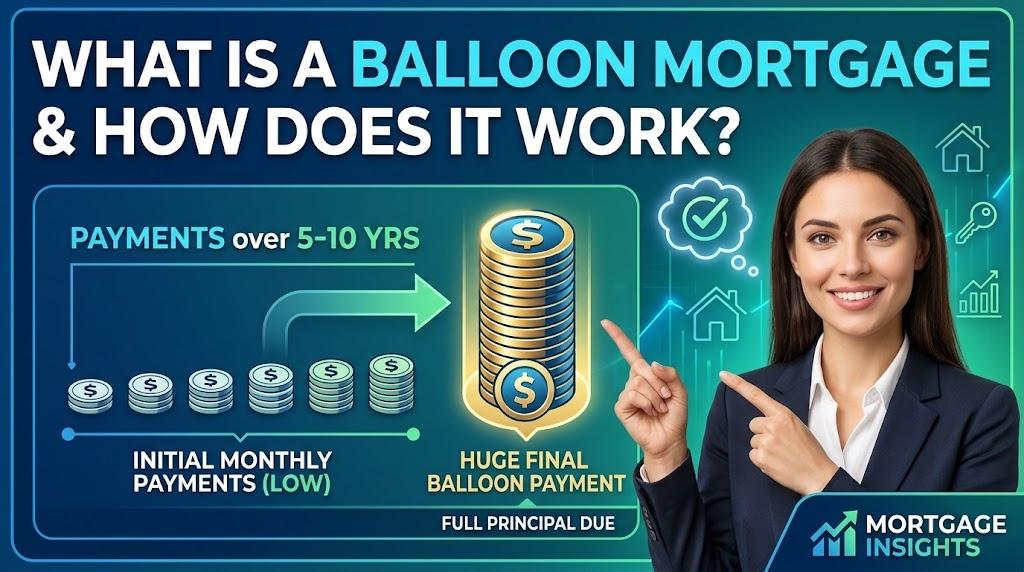
A balloon mortgage is a loan where you make regular monthly payments for a set period (typically 3-10 years), but those payments don't fully amortize the loan. At the end of the term, you owe a large "balloon" payment equal to most of your remaining principal balance.
How Does a Balloon Mortgage Work?
Example: 7-Year Balloon Mortgage
- Loan Amount: $300,000
- Interest Rate: 7%
- Monthly Payment: Based on 30-year amort = $1,996/mo
- Term: 84 months (7 years)
- Total Paid: $167,664
- Balloon Payment Due: $280,669
After seven years and nearly $168,000 in payments, you still owe 93.6% of the original loan. This is fundamentally different from a conventional mortgage.
Balloon Mortgage Pros and Cons
Advantages of Balloon Mortgages
- ✓ Lower Monthly Payments: 15-25% lower than fully amortizing loans
- ✓ Easier Qualification: Better debt-to-income ratios
- ✓ Short-Term Flexibility: Ideal for properties you plan to sell
- ✓ Business Cash Flow: Preserve capital for operations
- ✓ Bridge Financing: Perfect for temporary situations
Disadvantages of Balloon Mortgages
- ✠Massive Payment Risk: Must pay hundreds of thousands in one lump sum
- ✠Refinancing Uncertainty: Rates may be higher when balloon comes due
- ✠Market Dependency: Property values must support refinancing
- ✠Limited Equity Building: Only 5-10% equity after 5-7 years
- ✠Foreclosure Risk: Can't pay balloon = potential foreclosure
- ✠Higher Interest Rates: Usually 0.25-0.75% higher
When Balloon Mortgages Make Sense
Balloon mortgages make sense in specific, well-defined scenarios. Here are the situations where they can be smart financial tools:
6 Scenarios When Balloon Mortgages Work:
- 1. Short-Term Investment Property: Buying to renovate and sell within 3-5 years
- 2. Guaranteed Income Increase: Expecting substantial raise, inheritance, or business sale
- 3. Temporary Relocation: Moving for 3-5 years, plan to sell before balloon
- 4. Business with Growth Plan: Startup phase, expect strong revenue growth for refinancing
- 5. Transition Period: Credit improving, will qualify for better loan later
- 6. Multiple Exit Strategies: Can refinance, sell, OR pay balloon from other sources
Success Story: Phoenix House Flip
Maria, a Phoenix investor, used a balloon mortgage for investment property:
- Purchase: $275,000 fixer-upper with 5-year balloon
- Monthly Payment: $1,923 (vs $2,240 conventional)
- Strategy: Renovate and sell within 3 years
- Outcome: Sold for $385,000 after 2.5 years, paid balloon plus $68,000 profit
When to Avoid Balloon Mortgages
6 Scenarios to Avoid Balloon Mortgages:
- 1. First-Time Homebuyer: Planning to stay long-term
- 2. Uncertain Income: Unstable job or business revenue
- 3. No Exit Strategy: Hoping "something works out"
- 4. Volatile Market: Property in declining or unstable area
- 5. Maxed Out Budget: Can barely afford monthly payments
- 6. Poor Credit: Unlikely to qualify for refinancing later
Major Risks of Balloon Mortgages
1. Interest Rate Risk
If interest rates rise significantly, refinancing becomes more expensive or impossible. You could face monthly payments you can't afford or be forced to sell at an inopportune time.
2. Property Value Risk
If your property's value declines, you may owe more than it's worth, making refinancing or selling difficult. This "underwater" scenario trapped thousands during the 2008 financial crisis.
3. Income/Credit Risk
Job loss, business downturn, or credit score decline can disqualify you from refinancing, leaving you unable to pay the balloon.
âš ï¸ Cautionary Tale: 2008 Crisis Example
James bought a $450,000 home in Las Vegas with a 7-year balloon in 2004, planning to refinance in 2011:
- 2004: Home valued at $450,000, $400,000 balloon loan
- 2011: Home worth only $285,000 (down 37%)
- Balloon Due: $376,000
- Problem: Couldn't refinance (underwater), couldn't sell (owed more than value)
- Outcome: Foreclosure, credit destroyed
Frequently Asked Questions
Are balloon mortgages a good idea?
Balloon mortgages can be good for short-term investors, people with clear exit strategies, or those expecting income increases. They're risky for first-time homebuyers, those with uncertain income, or anyone without guaranteed refinancing options.
What happens when a balloon mortgage matures?
When a balloon mortgage matures, the entire remaining balance becomes due immediately. You must either pay it in cash, refinance, sell the property, or negotiate an extension. Failure to pay can result in foreclosure.
Why would someone choose a balloon mortgage?
People choose balloon mortgages for lower monthly payments (15-25% less than conventional), better cash flow, easier qualification, or short-term bridge financing. Real estate investors commonly use them for properties they plan to sell within 5-7 years.
Can you refinance a balloon mortgage before it matures?
Yes, you can refinance anytime before maturity, typically without prepayment penalties. Many borrowers refinance 1-2 years early if rates have dropped, credit improved, or property value increased significantly.
What is a 5/25 balloon mortgage?
A 5/25 balloon mortgage has payments calculated on a 30-year schedule, but the loan term is only 5 years. After 5 years, you owe approximately 95% of the original loan as the balloon payment.
Are balloon payments illegal?
No, balloon payments are legal but heavily regulated under Truth in Lending Act and Dodd-Frank Act. They're more common in commercial and investment property lending than primary residences.
How do I get out of a balloon mortgage?
To exit: (1) Refinance 12-18 months before balloon date, (2) Sell the property, (3) Make extra principal payments, (4) Negotiate extension with lender, or (5) Pay balloon with savings. Start planning at least 2 years early.
What are alternatives to balloon mortgages?
Alternatives include: ARMs (lower rates without balloon), Interest-Only Loans, Conventional 30-Year Fixed, FHA/VA Loans, Portfolio Loans, or Seller Financing. Each has different risk profiles and qualification requirements.
Making the Right Decision
Balloon mortgages are neither inherently good nor bad they're powerful financial tools that demand careful analysis and ironclad exit strategies. The success stories prove they can work brilliantly for short-term investors, business owners with growth plans, and strategic real estate moves. The cautionary tales prove they can be devastating for unprepared borrowers.
Before committing to a balloon mortgage, honestly assess: (1) Do you have a concrete plan to pay the balloon? (2) Do you have 2-3 backup exit strategies? (3) Can you handle refinancing at higher rates? (4) Is your income stable enough? (5) Does your property support future refinancing or sale?
If you can confidently answer yes to all these questions, a balloon mortgage might make sense. If you have doubts about any, consider safer alternatives. The lower monthly payments aren't worth the stress of scrambling to pay a six-figure balloon with no options.