Mortgage Advice
Practical guidance for smarter mortgage decisions.
Learn First
Understand your mortgage options.
Compare
Explore your mortgage choices.
Calculate
Use our tools to estimate your costs.
Understanding Mortgage Types
Choosing the right mortgage type is one of the most important decisions you'll make when buying a home. Each mortgage type has unique features, benefits, and considerations that can significantly impact your monthly payments and long-term financial health.
Fixed-Rate Mortgages
Fixed-rate mortgages offer stability and predictability. Your interest rate remains constant throughout the entire loan term, whether it's 15, 20, or 30 years. This means your monthly principal and interest payment never changes, making budgeting easier. Fixed-rate mortgages are ideal if you plan to stay in your home long-term or prefer the security of knowing exactly what you'll pay each month. They're particularly attractive when interest rates are low, as you can lock in that favorable rate for decades.
Adjustable-Rate Mortgages (ARMs)
ARMs typically start with a lower interest rate than fixed-rate mortgages, but that rate can change periodically based on market conditions. A common ARM structure is the 5/1 ARM, where your rate stays fixed for the first 5 years, then adjusts annually. ARMs work best if you plan to sell or refinance before the rate adjusts, if you expect your income to increase, or if you're comfortable with some payment uncertainty in exchange for initial savings. Most ARMs have rate caps that limit how much your rate can increase.
Government-Backed Loans (FHA, VA, USDA)
Government-backed loans make homeownership accessible to more buyers through lower down payment requirements and more flexible qualification standards. FHA loans require as little as 3.5% down and accept lower credit scores, though they require mortgage insurance. VA loans, available to eligible veterans and service members, offer 0% down with no PMI requirement. USDA loans provide 0% down financing for homes in eligible rural areas. These programs serve specific purposes and populations, offering pathways to homeownership that might otherwise be unavailable.
Jumbo Loans
Jumbo loans exceed the conforming loan limits set by Fannie Mae and Freddie Mac (typically $766,550 in most areas for 2024). These loans finance high-value properties but come with stricter requirements: higher credit scores (usually 700+), larger down payments (often 10-20%), lower debt-to-income ratios, and more substantial cash reserves. Interest rates on jumbo loans can be slightly higher or competitive with conforming loans, depending on market conditions and your financial profile.
How Interest Rates Work
Understanding interest rates is crucial because even a small difference in your rate can mean tens of thousands of dollars over the life of your loan. Your interest rate determines how much you'll pay to borrow money, directly affecting your monthly payment and total cost.
What Determines Your Interest Rate
Multiple factors influence the interest rate you'll receive. Your credit score is paramount higher scores (740+) typically qualify for the best rates, while lower scores result in higher rates to compensate for increased risk. Your down payment size matters too; putting down 20% or more usually secures better rates and eliminates PMI. The loan term affects your rate, with shorter terms (15 years) generally offering lower rates than longer terms (30 years). Your debt-to-income ratio, employment history, and the type of property you're buying all play roles. Market conditions, Federal Reserve policies, and the overall economy also influence the rates lenders offer.
Fixed vs Variable Rates
Fixed rates provide certainty your rate never changes regardless of market fluctuations. You're protected if rates rise but can't benefit if rates fall without refinancing. Variable rates (in ARMs) start lower but can adjust up or down based on index rates plus a margin. The initial lower rate can save money if you don't keep the loan long-term, but you risk higher payments if rates increase. Consider your risk tolerance, how long you'll keep the loan, and rate forecasts when choosing between fixed and variable.
APR vs Interest Rate
The interest rate is what you pay to borrow the principal, while the APR (Annual Percentage Rate) includes the interest rate plus other costs like origination fees, discount points, and mortgage insurance, expressed as a yearly rate. APR gives you a more complete picture of the loan's true cost. A loan with a lower interest rate might have a higher APR if it includes significant fees. Always compare APRs when shopping for mortgages a difference of even 0.25% in APR can cost thousands over the loan term.
How Rates Affect Your Payment
Interest rate changes dramatically impact your monthly payment and total interest paid. On a $300,000 30-year loan, the difference between 6% and 7% is about $180 per month and over $64,000 in total interest. This is why rate shopping is essential getting quotes from multiple lenders and negotiating can save substantial money. Even if you can't control market rates, improving your credit score, increasing your down payment, or choosing a shorter loan term can help you secure a better rate.
Down Payment Strategies
Your down payment is one of the most significant financial decisions in the home-buying process. The amount you put down affects your loan amount, monthly payment, interest rate, and whether you'll pay mortgage insurance. Understanding your options helps you make the best choice for your situation.
Standard 20% Down Payment
The traditional 20% down payment has long been considered the gold standard. Putting down 20% eliminates private mortgage insurance (PMI), which can cost 0.5% to 1% of the loan amount annually. You'll also typically get better interest rates, lower monthly payments, and build immediate equity in your home. A 20% down payment shows lenders you're financially stable and committed, making you a lower-risk borrower. However, saving 20% can take years on a $400,000 home, that's $80,000 which might not align with your timeline or financial goals.
Low Down Payment Options (3-5%)
Many buyers successfully purchase homes with much smaller down payments. Conventional loans allow as little as 3% down for first-time buyers, while FHA loans require just 3.5%. These low down payment options let you buy sooner and preserve cash for emergencies, home improvements, or investments. The trade-offs include PMI requirements, slightly higher interest rates, larger loan amounts, and higher monthly payments. However, buying sooner means building equity through appreciation and principal paydown rather than waiting years to save. Many buyers find that the benefits of homeownership outweigh the costs of PMI, which can be removed once you reach 20% equity.
PMI Considerations
Private Mortgage Insurance protects the lender if you default, required when you put down less than 20%. PMI typically costs $30-$70 per month for every $100,000 borrowed, adding $150-$350 monthly on a $500,000 loan. While PMI increases your payment, it's not permanent. For conventional loans, lenders must automatically cancel PMI when you reach 22% equity through payments, and you can request cancellation at 20% equity. You can also eliminate PMI by refinancing once you have 20% equity. FHA loans have mortgage insurance for the loan's life unless you refinance to a conventional loan. When evaluating options, calculate whether the time saved by buying sooner offsets the PMI cost.
Saving Strategies
Building your down payment requires discipline and strategy. Start by setting a specific goal and timeline if you need $40,000 in 4 years, that's roughly $833 per month. Automate transfers to a dedicated high-yield savings account to separate these funds from daily expenses. Cut discretionary spending by reducing dining out, subscriptions, or entertainment. Look for ways to increase income through side hustles, freelancing, or asking for a raise. Consider gift funds from family members most lenders allow gift money for part or all of your down payment with proper documentation. First-time buyer programs, down payment assistance programs, and employer benefits might offer additional resources. Track your progress regularly and adjust your strategy as needed to stay on target.
Browse by Topic
Essential Mortgage Guides

How to Qualify for a Mortgage: Key Requirements
Learn the key requirements to qualify for a mortgage in Canada. Understand income needs, credit scores, debt ratios (GDS/TDS), and down payment requirements with real Canadian examples.
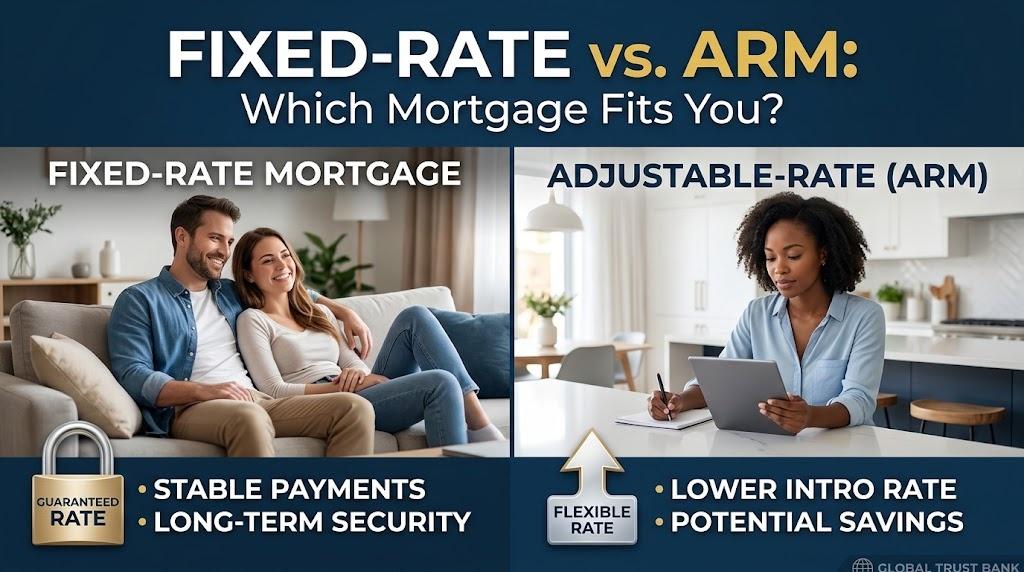
Fixed Rate vs ARM: Which Mortgage Fits You?
Compare fixed-rate and adjustable-rate mortgages to determine which loan type best fits your financial situation and homeownership timeline.
When Should You Refinance Your Mortgage?
Discover the best times to refinance your mortgage. Learn when rate drops, home equity gains, and life changes make refinancing worth it with real-world scenarios and break-even analysis.