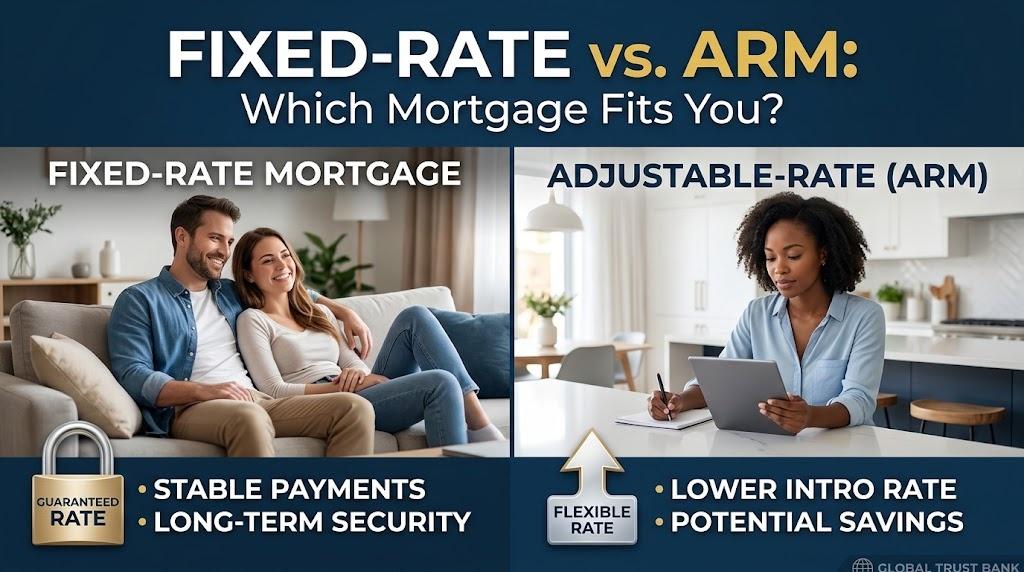
Choosing between a fixed-rate mortgage and an adjustable-rate mortgage (ARM) isn't about finding the objectively "better" option it's about discovering which structure fits your financial situation, ownership plans, and tolerance for uncertainty. A fixed-rate mortgage locks your interest rate for the entire loan term, providing complete payment predictability whether you keep it 5 years or 30 years. An ARM offers a lower initial rate for a set period (typically 5, 7, or 10 years), then adjusts periodically based on market rates, creating potential savings but introducing payment uncertainty. The right choice depends on how long you'll keep the property, whether you can handle payment increases, and how much you value certainty versus initial savings.
This guide helps you determine which mortgage fits your circumstances by examining real borrower profiles, comparing fixed vs arm rates across different timelines, and addressing the questions that matter most: Is a 7 year ARM a good idea right now for your situation? Is ARM better than fixed mortgage for short-term ownership? How do you compare total costs rather than focusing solely on initial payments? Understanding when each option makes sense and when it doesn't enables you to make a confident decision aligned with your financial reality, not generic advice or interest rate speculation.
Understanding Fixed-Rate Mortgages: Payment Certainty
A fixed-rate mortgage provides the ultimate payment predictability: your interest rate and monthly principal-and-interest payment remain unchanged for the entire loan term, typically 30 or 15 years in the United States. If you borrow $350,000 at 6.75% for 30 years, your payment of $2,270 stays constant in month 1, month 120, and month 360. While property taxes and insurance may change over time, your core mortgage payment never does unless you refinance. This certainty makes long-term budgeting straightforward and protects you from market interest rate increases if rates spike to 10%, your rate stays locked at your original 6.75%.
Who benefits most from fixed-rate mortgages:
- Long-term homeowners (10+ years): If you'll keep the property through retirement or have no definite move timeline, payment certainty for decades justifies the higher initial rate.
- Risk-averse borrowers: If payment uncertainty causes significant stress or your personality leans toward avoiding financial surprises, the peace of mind from fixed payments is valuable.
- Tight budget situations: When your budget has no room to absorb payment increases, fixed rates protect you from affordability shocks.
- Approaching retirement: Borrowers within 10-15 years of retirement benefit from knowing exactly what their housing costs will be on fixed income.
- Low-rate environments: When mortgage rates are historically low, locking that rate for 30 years provides long-term value even if paying slightly more than an ARM initially.
The tradeoff for this certainty is a higher initial interest rate. Lenders charge a premium to guarantee your rate for decades, meaning fixed vs arm mortgage rates typically show a 0.50-0.75% difference, with fixed rates higher. Whether this premium is worth paying depends on your circumstances for some borrowers, it's money well spent; for others, it's paying for certainty they'll never use.
Understanding Adjustable-Rate Mortgages: Lower Initial Cost with Adjustment Risk
An ARM provides a lower initial interest rate for a fixed introductory period commonly 5, 7, or 10 years then adjusts periodically based on a financial index plus the lender's margin. A 5/1 ARM has 5 years of rate stability followed by annual adjustments; a 7/1 ARM provides 7 years of certainty. During the initial period, your payment stays constant just like a fixed-rate mortgage, but typically at a rate 0.50-0.75% lower. After the fixed period ends, your rate adjusts based on current market conditions, which could mean higher payments, lower payments, or staying roughly the same.
How ARM adjustments work after the fixed period:
- 1. Index rate: Your new rate ties to a specific financial index (like SOFR, Treasury yields, or prime rate) that reflects current market interest rates.
- 2. Plus margin: The lender adds a fixed percentage (the margin, set at origination) to the index. If the index is 4.5% and your margin is 2.5%, your new rate becomes 7.0%.
- 3. Subject to rate caps: Contractual limits protect you from unlimited increases. Common cap structures (2/2/5) mean: 2% maximum on first adjustment, 2% maximum on subsequent adjustments, 5% lifetime maximum above start rate.
- 4. New payment calculation: The adjusted rate applies to your remaining balance over the remaining term, generating a new monthly payment.
Who benefits most from ARMs:
- Short-term owners: If you'll definitively sell or refinance within the fixed period (military relocation, starter home with upgrade timeline, temporary job assignment), you capture all savings with zero adjustment risk.
- Strong refinance candidates: Borrowers with excellent credit, building equity rapidly, and stable income who can confidently refinance before or shortly after adjustment.
- Financially flexible households: If your income provides cushion to absorb payment increases, or you have substantial reserves, adjustment risk is manageable.
- High initial-payment sensitivity: When qualifying for a fixed-rate mortgage is difficult but the lower ARM payment makes the purchase feasible though only if you can afford worst-case adjustments.
The key mistake: choosing an ARM solely because the initial payment is lower, without stress-testing whether you can afford worst-case adjusted payments. Use a fixed rate vs arm mortgage calculator to model various adjustment scenarios if you can't afford payments at the lifetime cap, an ARM introduces excessive risk regardless of initial savings.
Which Mortgage Fits Your Profile?
The question "is ARM better than fixed mortgage" or "is fixed or adjustable rate better" depends entirely on your circumstances. Let's examine hypothetical borrower profiles to illustrate when each option makes sense. All figures are for illustration only and use assumed rates actual rates vary by borrower, lender, and market conditions.
Profile 1: Long-Term Homeowner (10+ Years)
Situation: You're buying your "forever home," plan to stay at least 15-20 years, or have no definite timeline to move. You value budgeting certainty and want to eliminate interest rate risk.
Hypothetical Example: $350,000 loan, 30-year term
30-Year Fixed @ 6.75%
- Monthly P&I: $2,270
- Payment never changes
- Total interest (30 yrs): ~$467,000
5/1 ARM @ 6.00%
- Initial monthly P&I: $2,098
- Years 1-5 savings: $10,320
- Then adjusts annually
Analysis: While the ARM saves $172/month initially ($10,320 over 5 years), you face 25 years of potential adjustments. If rates increase even moderately after year 5, cumulative ARM payments likely exceed the fixed option. Over 15-20 years, multiple adjustment cycles in uncertain rate environments favor the fixed-rate certainty.
✓ Verdict: Fixed-Rate Fits Better
Profile 2: Short-Term Owner (5-7 Years)
Situation: You're confident you'll sell within 5-7 years military assignment, starter home with definite upgrade plans, temporary job location, or expecting family size changes that require moving.
Hypothetical Example: Same $350,000 loan
5-Year Comparison:
- Fixed @ 6.75%: Total paid over 5 years = $136,200 (60 months à $2,270)
- 5/1 ARM @ 6.00%: Total paid over 5 years = $125,880 (60 months à $2,098)
- ARM Savings: $10,320
- You sell before the ARM adjusts captured all savings with zero adjustment risk
Analysis: Since you'll sell within the ARM's fixed period, you capture the full $10,320 savings without facing any adjustment risk. The fixed vs adjustable rate decision favors the ARM when your ownership timeline fits entirely within the fixed period. Even if your plans change slightly and you keep the home to year 6 or 7, one or two adjustments are unlikely to eliminate all your initial savings.
✓ Verdict: ARM Fits Better
Profile 3: Move-Up Buyer (7-10 Years)
Situation: You're buying a home you'll likely outgrow family expansion expected, career progression anticipated, or planning to upgrade in 7-10 years. You want more initial savings than a 5/1 ARM but aren't committing to 30 years.
Hypothetical Example: $400,000 loan, comparing 7/1 ARM
30-Year Fixed @ 6.875%
- Monthly P&I: $2,629
- 7-year total: $220,836
7/1 ARM @ 6.125%
- Initial monthly P&I: $2,426
- 7-year total: $203,784
- Savings: $17,052
Analysis: The 7/1 ARM vs 30-year fixed rates comparison shows substantial savings ($17,052) over 7 years. If you sell in year 8-9, you've captured most savings before significant adjustments accumulate. A 7/1 ARM calculator helps model scenarios where you keep the loan slightly beyond year 7 one or two adjustments are unlikely to eliminate your cumulative advantage if you move by year 10.
✓ Verdict: 7/1 ARM Often Fits Better (if timeline holds)
Total Cost vs. Initial Payment: Why Ownership Timeline Matters
A common mistake when comparing fixed vs adjustable rate options is focusing solely on initial monthly payments. While an ARM's lower initial payment is attractive, total cost depends on how long you keep the loan and how rates adjust. An arm vs fixed rate calculator should model cumulative costs over your realistic ownership period, not just compare month 1 payments.
Total Cost Analysis Framework:
If keeping the loan 5 years or less:
Compare total payments through year 5. ARM saves money if you sell before adjustment. Fixed-rate premium buys certainty you won't use.
If keeping the loan 7-10 years:
Calculate break-even point where ARM adjustments eliminate initial savings. 7/1 ARM provides more protection than 5/1 ARM for this timeline. Compare cumulative costs including adjustment scenarios.
If keeping the loan 15+ years:
Fixed-rate typically costs less cumulatively unless rates decline significantly. Multiple ARM adjustment cycles introduce too much uncertainty payment predictability becomes more valuable than initial savings.
Use a fixed vs arm mortgage calculator to model your specific timeline. Input various adjustment scenarios rates stay flat, increase 1-1.5%, or hit maximum caps. If your likely ownership period shows ARM costs exceeding fixed-rate costs in moderate scenarios, the initial savings aren't worth the long-term risk. Conversely, if you're selling before adjustments, paying extra for fixed-rate certainty wastes money.
Answering Your Key Questions
"Is a 7 year ARM a good idea right now?"
The answer isn't about "right now" in terms of current market rates it's about YOUR situation right now. A 7-year ARM makes sense if: (1) you'll definitively sell or refinance within 7-10 years; (2) you can afford worst-case payments at lifetime cap rates; (3) the initial savings meaningfully improve your financial flexibility; and (4) you're not relying on refinancing as your only exit strategy. Market rate levels change constantly, but your ownership timeline and risk tolerance are the decisive factors. Don't choose a 7/1 ARM because you think rates are high and will decline choose it because your circumstances align with the product structure.
"Is ARM better than fixed mortgage?"
Neither is universally better. ARMs are better for short-term owners (5-7 years), financially flexible borrowers who can handle payment increases, and situations where initial savings are captured before adjustment risk materializes. Fixed-rate mortgages are better for long-term owners (10+ years), tight budgets that can't absorb increases, risk-averse borrowers, and those approaching retirement. The fixed rate vs adjustable rate decision depends on your ownership timeline, financial flexibility, and tolerance for uncertainty not which product is objectively superior.
"What are 10 year ARM rates right now?"
Mortgage rates fluctuate daily based on economic conditions, Federal Reserve policy, Treasury yields, and individual borrower qualifications. Rather than citing a specific rate that may be outdated when you read this, understand that ARM initial rates typically run 0.50-0.75% below comparable fixed rates. A 10/1 ARM (10-year fixed period) usually has a slightly higher initial rate than a 5/1 or 7/1 ARM because the lender locks the rate longer. For current rates: get quotes from multiple lenders, compare the spread between fixed and ARM options, and verify rate cap structures. What matters isn't today's exact rate but understanding how your quotes compare and whether the ARM's initial rate advantage justifies adjustment risk for your situation.
"What is the 2 2 2 rule for mortgages?"
The "2 2 2 rule" isn't a widely standardized industry term with a single definition. Some borrowers use it to refer to ARM rate cap structures (2% initial adjustment cap, 2% periodic cap, though the lifetime cap is typically 5-6%, not 2%). Others may refer to different guidelines or rules of thumb. Rather than relying on shorthand phrases, focus on understanding your specific ARM's documented cap structure, which will be clearly stated in your loan estimate and closing documents. Always verify: initial adjustment cap, periodic adjustment cap, and lifetime cap these are your contractual protections against unlimited rate increases.
Canadian Mortgage Context: Different Structure
Canadian borrowers searching for "Fixed vs arm calculator canada" should note that Canadian mortgages operate differently from U.S. ARMs. In Canada, mortgages use term-based structures where you choose a rate term (1, 3, 5, or 10 years) for a fixed or variable rate, while the full amortization remains 25-30 years. At each term end, you must renew at prevailing rates. This means even "fixed-rate" Canadian mortgages aren't truly fixed for 30 years like U.S. fixed-rate mortgages they're fixed for the chosen term only.
The Canadian "fixed vs. variable" decision is somewhat analogous to U.S. "fixed vs. ARM" but with important differences. Canadian variable-rate mortgages adjust with prime rate changes throughout the term, while U.S. ARMs have initial fixed periods. If you're comparing Canadian mortgage options, use calculators designed for Canadian term structures and understand that your decision involves choosing term length (1-10 years) in addition to fixed vs. variable rates. The concepts of ownership timeline and risk tolerance still apply, but the specific mechanics differ from U.S. ARM products.
Making Your Fixed vs. ARM Decision
Now that you understand both options and have seen how they fit different borrower profiles, here's a decision framework:
6-Step Decision Framework:
- 1. Define your realistic ownership timeline
Be honest: Will you definitively sell within 5-7 years, or is that hopeful thinking? Uncertain timelines favor fixed rates. - 2. Calculate worst-case ARM payments
Use an ARM APR calculator or 5/1 ARM vs 30-year fixed calculator to determine your payment at lifetime cap rates. Can you afford it? - 3. Compare total costs over your timeline
Model cumulative costs through your expected ownership period using multiple rate scenarios, not just initial payments. - 4. Assess your financial flexibility
Do you have income room for payment increases? Emergency reserves? Or is your budget tight? - 5. Evaluate your risk tolerance
Will payment uncertainty cause significant stress? If so, fixed-rate peace of mind may be worth the premium. - 6. Don't rely on refinancing assumptions
Treat refinancing as a potential benefit, not your strategy. Choose based on whether you can handle the mortgage without refinancing.
Remember: There's no universally correct answer to "a fixed rate or adjustable rate better" or "is fixed or adjustable rate better." The right choice aligns your mortgage structure with your specific circumstances. Use fixed vs arm mortgage rates comparisons and calculators to model YOUR situation with YOUR timeline, not generic scenarios. Make the decision based on what you can afford and how long you'll keep the property, not interest rate predictions or market timing.