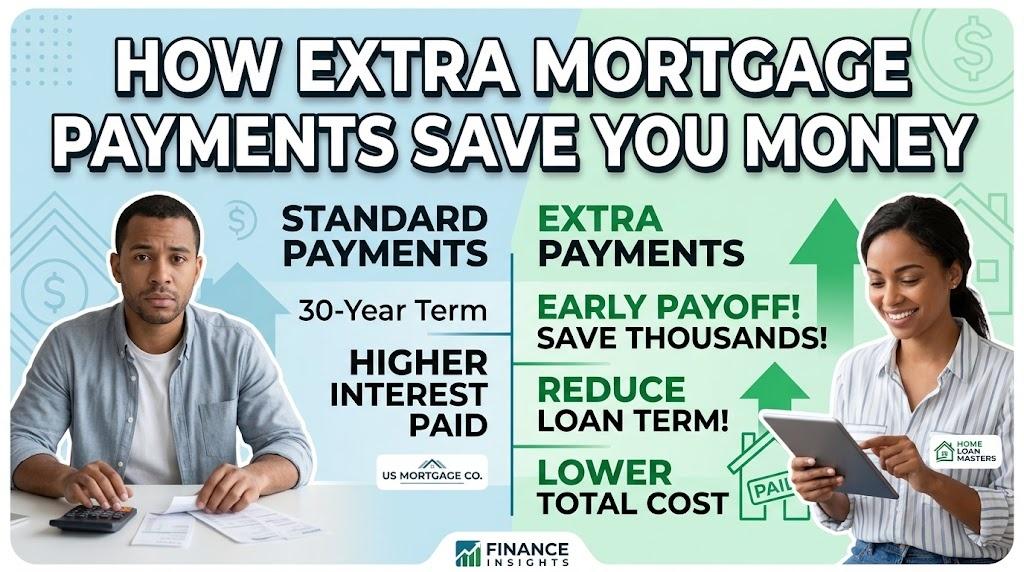
In February 2020, Patricia Williams refinanced her Vancouver condo with a $425,000 mortgage at 3.89% over 25 years. Her required payment was $2,231 monthly. That same month, she made a decision that would ultimately save her $94,300 and seven years of payments: she increased her monthly payment to $2,500 just $269 extra and committed to $8,000 annual lump sum payments each March using her tax refund and annual bonus.
Five years later, in early 2025, Patricia checked her mortgage statement and discovered something remarkable. While friends who bought homes the same year still owed $380,000-$390,000, her balance had dropped to $289,000. She'd paid off $136,000 in principal $40,000 more than her peers making minimum payments. "People ask how I paid off so much," Patricia said. "The answer isn't dramatic. I just made extra payments every single month and every spring without fail. The compound effect did the rest."
This comprehensive guide explains exactly how extra mortgage payments save you money through seven proven strategies Canadian homeowners use to eliminate debt years early. You'll learn how to calculate extra principal payments, discover whether it's good to pay extra principal for your specific situation, understand what happens if you pay an extra $100 a month on your mortgage principal (and $200, $300, $500), and determine how much extra you should pay towards your principal based on your financial goals and circumstances.
How Extra Principal Payments Actually Save Money: The Compound Effect
Every mortgage payment splits between principal (reducing your loan balance) and interest (the lender's cost). Early payments are mostly interest because you owe the full amount. When you make an extra principal payment, that entire amount reduces your balance immediately zero goes to interest.
This creates a compound snowball effect: Lower balance means next month's interest charge is smaller, so more of your regular payment goes to principal, further reducing the balance. Each extra dollar eliminates future interest charges that would have accumulated for years or decades.
Real Example: What Happens If You Pay an Extra $100 a Month on Your Mortgage Principal
Baseline: Carlos Martinez in Brampton has a $365,000 mortgage at 5.99% over 25 years. Monthly payment: $2,387. Without extra payments, he'll pay $351,100 in total interest over 25 years.
With $100 extra monthly ($2,487 total payment):
- ✓ Payoff time: 21.5 years instead of 25 years
- ✓ Total interest paid: $299,850 instead of $351,100
- ✓ Interest savings: $51,250
- ✓ Time saved: 3.5 years
- ✓ Total extra payments made: $25,800 (216 months à $100)
- ✓ Return on investment: 198% ($51,250 saved ÷ $25,800 invested)
Is it good to pay extra principal? For Carlos, absolutely. His $100 monthly extra investment yields a 198% return through interest savings far exceeding typical investment returns. However, the answer depends on your interest rate, other debt, emergency savings, and investment opportunities, which we'll explore below.
Principal and Interest Calculation Example
Hypothetical Scenario: Consider a home purchase with these assumptions: $350,000 home price, 10% down payment ($35,000), loan amount of $315,000, interest rate of 6.5%, and a 30-year term.
Using the formula: The monthly interest rate is 6.5% ÷ 12 = 0.00542. The number of payments is 30 years à 12 = 360 months. Plugging these into the formula yields a principal and interest payment of approximately $1,991 per month. Over 30 years, you'll pay roughly $716,760 total the original $315,000 principal plus $401,760 in interest.
This demonstrates how interest significantly impacts your total cost. Even a simple mortgage payment calculator showing only principal and interest reveals this relationship, helping you compare different loan amounts and interest rates quickly.
How Down Payment Affects Your Loan Amount
Your down payment directly reduces the loan amount you need to borrow. A down payment mortgage calculator helps you see this impact clearly. Using our previous example: with 5% down ($17,500), you'd borrow $332,500 with a monthly P&I payment of about $2,102. With 20% down ($70,000), you'd borrow $280,000 with a monthly P&I payment of roughly $1,770.
The 20% down payment saves you $332 monthly in principal and interest alone nearly $4,000 annually and almost $120,000 over the loan's life. Beyond lower payments, larger down payments often secure better interest rates and eliminate private mortgage insurance requirements, compounding your savings.
Beyond Principal and Interest: Complete Payment Components
While principal and interest form the base payment, your actual monthly housing cost includes additional components. A comprehensive mortgage payment calculator with taxes and insurance provides a complete picture of what you'll actually pay each month. Understanding these components helps you budget accurately and avoid surprises after closing.
Property Taxes
Property taxes fund local services like schools, roads, and emergency services. Rates vary dramatically by location from under 0.5% annually in some areas to over 2.5% in others. Most lenders require you to pay property taxes through an escrow account, dividing the annual amount into monthly payments included in your mortgage bill.
Hypothetical Example: On a $350,000 home in an area with 1.5% property tax, annual taxes are $5,250, or roughly $438 monthly. In areas like Ontario or BC in Canada, effective rates might be 0.7-1.0%, resulting in $204-292 monthly. In California or Alberta, rates could be 1.0-1.2%, yielding $292-350 monthly. Always research local tax rates many municipalities publish assessment data online.
Homeowners Insurance
Lenders require homeowners insurance to protect their investment in your property. Insurance costs depend on home value, location, coverage level, deductible amount, and local risks like floods or earthquakes. Most policies cost $800-2,000 annually ($67-167 monthly) for typical homes, though premiums can be substantially higher in high-risk areas.
Hypothetical Example: A $350,000 home might require $1,400 annual insurance ($117 monthly) in a low-risk area, or $2,400 annually ($200 monthly) in a coastal region with hurricane exposure. In the UK, building insurance costs vary by region and property age but typically run £200-500 annually, while in Canada, premiums generally fall between $900-1,800 annually depending on province and coverage.
Private Mortgage Insurance (PMI)
When you put down less than 20%, lenders typically require PMI to protect against default risk. PMI costs 0.3% to 1.5% of the loan amount annually, depending on your down payment size and credit score. Unlike other components, PMI eventually cancels once you reach 20% equity through payments and home appreciation.
Hypothetical Example: With 10% down on a $350,000 home, you borrow $315,000. At 0.7% PMI, you'd pay $2,205 annually, or about $184 monthly. This PMI would drop off after approximately 7-8 years as you build equity through payments and modest appreciation. With just 5% down, PMI might be 1.0%, costing $264 monthly another reason to save for a larger down payment when possible.
HOA Fees and Other Costs
Condominiums and planned communities often charge homeowners association (HOA) fees for maintenance, amenities, and shared services. These vary from $100-600+ monthly depending on what's included. Some cover exterior maintenance, landscaping, and basic utilities, while others fund extensive amenities like pools, fitness centers, and security. Since HOA fees aren't part of the mortgage, not all calculators include them, but they're essential for total housing cost calculations.
Complete Monthly Payment Breakdown
Hypothetical Complete Scenario: $350,000 home, 10% down payment ($35,000), $315,000 loan at 6.5% for 30 years, property in an area with 1.5% annual property tax:
- Principal & Interest: $1,991
- Property Taxes: $438 (1.5% of $350,000 ÷ 12)
- Homeowners Insurance: $142 ($1,700 annual ÷ 12)
- PMI: $184 (0.7% of $315,000 ÷ 12)
- HOA Fees: $225
- Total Monthly Payment: $2,980
This complete view shows why a mortgage payment calculator with taxes and insurance is crucial. The principal and interest alone ($1,991) represents only 67% of your actual monthly cost. Budgeting for just P&I would leave you short by nearly $1,000 monthly a potentially devastating oversight.
The Impact of Extra Payments
A mortgage payment calculator with extra payments reveals one of the most powerful wealth-building strategies: making additional principal payments. Every extra dollar you pay toward principal reduces your loan balance immediately, which decreases interest charges on all future payments and accelerates your payoff date.
Hypothetical Extra Payment Example: Using our $315,000 loan at 6.5% for 30 years with a $1,991 monthly P&I payment: Adding just $200 extra monthly reduces your loan term from 360 months to 289 months shortening it by 71 months (nearly 6 years). Total interest paid drops from $401,760 to $317,445 saving $84,315 over the life of the loan.
Even small extra payments make a difference. An additional $100 monthly on this same loan saves $46,000 in interest and cuts 40 months from the term. The earlier in your loan you make extra payments, the more powerful their effect, since you're reducing the principal that future interest calculations are based upon.
Comparing and Using Mortgage Payment Calculators
When conducting a mortgage payment calculator comparison, you'll notice different tools serve different purposes. A simple mortgage payment calculator shows only principal and interest ideal for quick loan amount comparisons. Comprehensive calculators include taxes, insurance, PMI, and HOA fees better for accurate budgeting. Specialized calculators explore scenarios like extra payments, different payment frequencies, or adjustable-rate mortgages.
Many homebuyers search for specific institutional calculators, looking for "mortgage payment calculator TD" or "mortgage payment calculator CIBC" when they're current customers of those banks. While many Canadian financial institutions offer mortgage calculators on their websites, third-party tools often provide more flexibility and aren't tied to a specific lender's products. The underlying mathematics remain identical regardless of which calculator you use what matters is ensuring you input accurate information and understand what the calculator includes in its estimates.
Interpreting Calculator Results
Understanding what calculators show and don't show is critical. Most display your monthly payment, total interest over the loan life, and total amount paid. Some provide amortization schedules showing how each payment divides between principal and interest. Advanced calculators might show your loan-to-value ratio, equity build-up over time, or payoff progress.
Remember that calculator results are estimates. Your property taxes depend on your specific home's assessed value and can change annually. Insurance premiums vary by provider and coverage choices. Interest rates fluctuate daily, and the rate you actually qualify for depends on your credit score, down payment, and lender policies. Use calculators for planning and comparison, but obtain detailed quotes from actual lenders before making final decisions.
Geographic and Lender Variations in Payment Calculations
Where you buy significantly impacts your mortgage payment beyond just home prices. Searching for "mortgage payment calculator Ontario," "mortgage payment calculator BC," "mortgage payment calculator Alberta," or "mortgage payment calculator California" reflects the reality that location-specific costs vary tremendously. Property tax rates differ by state, province, and even municipality. Insurance costs reflect local risks like earthquakes, hurricanes, or wildfires.
In Canada, mortgage calculations have unique features. Canadian mortgages typically use semi-annual compounding rather than monthly, which slightly affects the effective interest rate. A mortgage payment calculator Canada should account for this difference. Additionally, Canadian mortgage terms often differ from amortization periods you might have a 25-year amortization with a 5-year term, after which you renegotiate rates. Down payment requirements and mortgage insurance rules (CMHC insurance for down payments under 20%) also differ from U.S. standards.
In the UK, mortgage payment calculator results reflect different conventions as well. UK lenders often quote annual percentage rates (APR) that include fees, making comparison easier but requiring different calculation methods. Stamp duty (transfer tax) adds significant upfront costs, and mortgage terms commonly run 20-25 years rather than 30.
Lender-specific factors also affect actual payments. Some lenders have higher or lower PMI rates based on their risk models. Escrow account requirements vary some lenders require tax and insurance escrow, others make it optional above certain down payment thresholds. Servicing fees, though typically small, can differ between lenders. This is why your actual payment might vary slightly from calculator estimates, even with identical loan terms.
From Payment Calculation to Affordability
While payment calculators show what a specific loan costs monthly, a mortgage affordability calculator works backward from your income and debts to determine what you can borrow. Lenders typically use debt-to-income (DTI) ratios: your housing payment shouldn't exceed 28% of gross monthly income (front-end ratio), and total debts shouldn't exceed 36-43% (back-end ratio).
Hypothetical Affordability Example: With $100,000 annual income ($8,333 monthly), the 28% front-end ratio allows $2,333 monthly for housing costs. Subtracting estimated taxes ($350), insurance ($125), and PMI ($150) leaves $1,708 for principal and interest. At 6.5% for 30 years, you can afford a loan of roughly $270,000. Add your down payment to find your maximum home price with 10% down, you'd qualify for approximately a $300,000 home. Use payment calculators to fine-tune your target once you know your affordability range.
Making Informed Decisions with Payment Calculators
Mortgage payment calculators are essential tools for home financing decisions, whether you're evaluating affordability, comparing loan options, or planning your payoff strategy. Understanding how these calculators work from the mathematical formulas they use to the components they include helps you interpret results accurately and avoid costly surprises.
Start with comprehensive calculators that include taxes, insurance, and PMI for realistic payment estimates. Compare different scenarios: larger versus smaller down payments, 15-year versus 30-year terms, or the impact of extra payments. Research location-specific costs like property tax rates and insurance premiums in your target area. Finally, remember that calculator estimates are starting points obtain detailed quotes from multiple lenders to understand your actual costs and available options before committing to a mortgage.