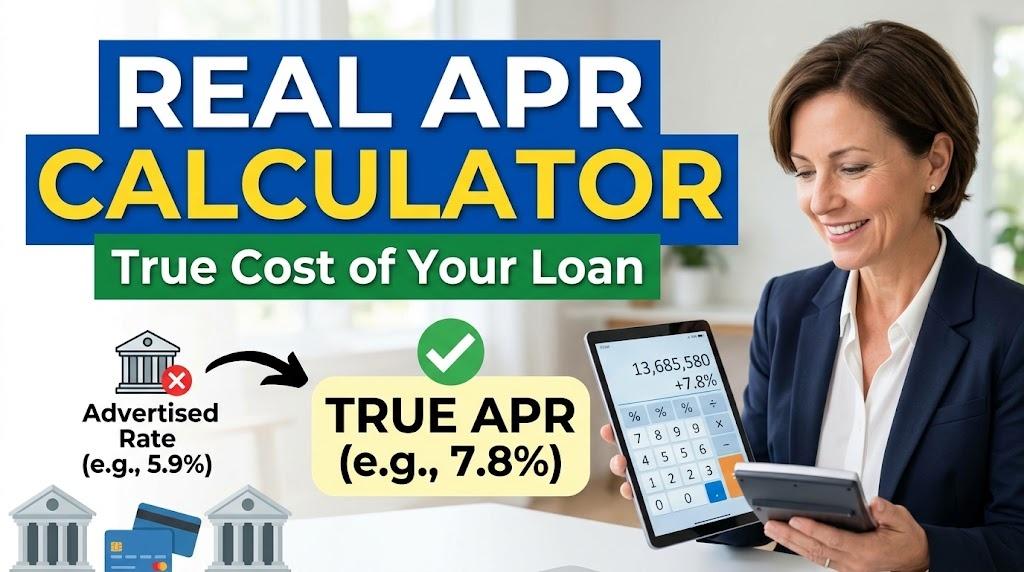
When comparing loan offers, the interest rate alone doesn't tell the complete story. APR Annual Percentage Rate reveals the true cost of borrowing by including not just the interest rate but also origination fees, closing costs, discount points, and other charges rolled into a single annualized percentage. Understanding the difference between interest rate and APR empowers you to compare loans accurately, identify hidden costs, and choose the option that truly saves you money over the life of the loan.
This article explains what APR means, how it's calculated conceptually (without overwhelming math), and why it varies dramatically across different loan types personal loans, auto loans, credit cards, and mortgages. You'll learn how to use APR as a comparison tool, understand daily APR calculations for credit cards, evaluate whether a specific APR is competitive for your situation, and see clear hypothetical examples that demonstrate APR's impact on your borrowing costs. By the end, you'll be equipped to ask lenders the right questions and make informed decisions about any loan offer. Note: This article covers loan APR, not cryptocurrency staking or investment APR which represents a different financial concept.
What Is APR and Why It Matters
APR stands for Annual Percentage Rate, representing the total annualized cost of borrowing money. While the interest rate shows what you'll pay in interest on the principal alone, APR includes the interest rate plus additional borrowing costs: origination fees, broker fees, discount points, prepaid interest, and certain closing costs spread over the loan term and expressed as a single percentage.
Hypothetical Example: Consider two personal loan offers for $10,000 over 5 years. Offer A has a 7% interest rate with no fees. Offer B has a 6.5% interest rate but charges a $500 origination fee (5% of the loan). At first glance, Offer B looks better because of the lower interest rate. However:
- Offer A: 7% interest rate, 7% APR (no fees), monthly payment approximately $198
- Offer B: 6.5% interest rate, approximately 7.4% APR (fees included), monthly payment approximately $200 on the $10,500 financed
Despite Offer B's lower interest rate, its higher APR reveals it's actually more expensive. The $500 fee effectively raises your borrowing cost above Offer A. APR standardizes this comparison, letting you evaluate loans with different fee structures on equal footing. This is why lenders in the United States must disclose APR under the Truth in Lending Act, and similar regulations exist in many other countries including the UK's Consumer Credit Act.
Interest Rate vs. APR: Key Differences
The interest rate is the percentage charged on the borrowed principal, determining how much interest accumulates each payment period. APR includes that interest rate plus the cost of fees, expressed as if those fees were additional interest spread over the loan term. Think of it this way:
- Interest Rate: What the lender charges for lending you money
- APR: What you actually pay to obtain and carry that loan, including fees
APR can never be lower than the interest rate (unless there are lender credits that offset fees, which is rare). If a loan has any fees whatsoever, APR will be higher than the interest rate. The only time APR equals the interest rate is when there are absolutely zero fees charged for the loan.
How APR Is Calculated (Conceptual Understanding)
APR calculation is mathematically complex because it requires solving for an effective interest rate that accounts for both the interest charged and the fees paid, spread over your payment schedule. Rather than simple arithmetic, it involves financial formulas that equate the present value of your loan payments (based on the total amount financed including fees) with the actual cash you receive.
Conceptual Process: To calculate APR, you need to determine what annual interest rate would produce the same monthly payment on the cash amount you receive as you'll actually pay on the total amount financed. For example, if you borrow $10,000 but $500 is deducted as a fee (so you receive $9,500 cash), you're paying interest on $10,000 to repay $10,000 but you only got $9,500. The APR calculation determines the effective rate that reflects this gap.
What's Included in APR
- Origination fees (typically 1-5% of the loan amount)
- Discount points (if you pay points to lower your rate)
- Broker fees (for loans arranged through brokers)
- Prepaid interest (interest from closing to first payment)
- Certain closing costs (lender-required fees directly tied to obtaining the loan)
What's Excluded from APR
- Late payment fees (contingent on your behavior)
- Returned check fees (optional/contingent)
- Title insurance (third-party service in most cases)
- Appraisal fees (for some mortgage types)
- Optional credit insurance (you choose whether to buy)
- Early payoff penalties (in most APR calculations)
Because fee inclusion rules vary slightly by loan type and jurisdiction, always ask lenders which specific fees are included in their APR calculation. Most use financial calculators or software that follow regulatory formulas it's not something borrowers calculate manually. Instead, you compare the APR figures lenders are required to disclose.
APR Across Different Loan Types
APR works the same conceptually across loan types it includes interest plus fees but the typical APR ranges, fee structures, and what constitutes a competitive APR vary dramatically depending on the loan category, collateral, and term length.
Personal Loans: Unsecured Borrowing
Personal loans are typically unsecured (no collateral), so lenders charge higher interest rates to compensate for default risk. APRs commonly range from single digits for borrowers with excellent credit to 30%+ for those with challenged credit. Origination fees typically run 1-5% of the loan amount, directly increasing the APR above the stated interest rate.
Hypothetical Example: Consider a $15,000 personal loan for home improvements with a 60-month (5-year) term:
- Interest Rate: 9.5%
- Origination Fee: 2% ($300)
- Amount Financed: $15,000
- Cash Received: $14,700 (after $300 fee deducted)
- Monthly Payment (on $15,000 at 9.5%): approximately $314
- Effective APR: approximately 10.3%
The 2% origination fee adds roughly 0.8 percentage points to the APR. For personal loans, always compare APR across lenders a loan with a slightly higher interest rate but lower fees may have a better APR than one with a lower rate and high upfront costs.
Auto Loans: Secured by Vehicle
Auto loans are secured by the vehicle, so they typically carry lower APRs than personal loans. New car loans often have lower rates than used car loans because new cars hold value better as collateral. Dealer financing may include documentation fees, dealer fees, and other charges that increase APR above the advertised interest rate.
Hypothetical Example: Financing a $25,000 vehicle over 60 months:
- Interest Rate: 4.5%
- Dealer Documentation Fee: $500
- Acquisition Fee: $250
- Total Fees: $750
- Monthly Payment (on $25,750): approximately $480
- Effective APR: approximately 5.2%
The $750 in fees increases APR by about 0.7 percentage points. When comparing dealer financing to bank or credit union auto loans, compare APR not just the interest rate. Dealers may advertise "4.5% financing!" but the APR tells the real story after fees. Banks and credit unions often have fewer fees, resulting in APR closer to the interest rate.
Credit Cards: Revolving Credit with Daily APR
Credit card APR works differently from term loans because credit cards are revolving credit you can borrow, repay, and borrow again up to your limit. Credit card APRs are typically much higher than secured loans (commonly 15-30% or more) because there's no collateral, higher default risk, and the cost of providing flexible borrowing.
Critical Distinction: Credit card APR is expressed annually but applied daily. To calculate daily interest charges, divide the APR by 365 to get your daily periodic rate, then multiply by your daily balance.
Daily APR Calculation Formula:
Daily Rate = APR ÷ 365
Daily Interest = Balance à Daily Rate
Monthly Interest = Daily Interest à Days in Billing Cycle
Hypothetical Example: How much is 26.99% APR on a $3,000 balance?
- APR: 26.99%
- Daily Rate: 26.99% ÷ 365 = 0.0739% per day (0.0007394 in decimal)
- Daily Interest on $3,000: $3,000 Ã 0.0007394 = approximately $2.22/day
- Monthly Interest (30-day cycle, no payments): $2.22 Ã 30 = approximately $66.60
- Annual Interest (if balance stayed $3,000 for a full year): approximately $809.70
This calculation assumes you make no payments and the balance remains $3,000. In reality, if you make monthly payments, your balance decreases and so does the interest charged. However, if you only make minimum payments (typically 2-3% of the balance), it could take many years to pay off the debt, and you'd pay thousands in total interest. The best strategy: pay your full statement balance each month to avoid interest charges entirely, or pay as much above the minimum as possible.
Mortgages: Long-Term Secured Loans
Mortgage APR includes the interest rate plus closing costs (origination fees, points, broker fees) spread over the loan term. Because mortgages have very long terms (typically 15-30 years), fees have less impact on APR than with shorter-term loans. A $2,000 origination fee spread over 30 years affects APR much less than the same fee on a 5-year personal loan.
Hypothetical Example: Compare two 30-year mortgage offers on a $300,000 loan:
Offer A:
Interest Rate: 6.5%
Closing Costs: $3,000
APR: approximately 6.65%
Monthly P&I Payment: $1,896
Offer B:
Interest Rate: 6.25%
Closing Costs: $7,500
APR: approximately 6.52%
Monthly P&I Payment: $1,847
Offer B has a lower interest rate but higher closing costs. The APR reveals that Offer B is actually more expensive over the loan's lifetime. However, APR assumes you keep the loan for the full 30 years. If you plan to refinance or sell within 5-7 years, the lower interest rate (Offer B) might save more money despite higher upfront costs. This is where APR has limitations it's most accurate for borrowers who keep loans to term.
Is [X] APR Good? Understanding Context
There's no universal answer to whether a specific APR is "good" or "bad" because it depends entirely on context: loan type, credit profile, loan term, secured vs. unsecured, and market conditions. An APR that's excellent for one loan type might be poor for another. Instead of seeking universal judgments, evaluate APR relative to your specific situation.
Is 2.9% APR Good? It Depends
For Auto Loans (New Vehicle): If you have excellent credit (score above 720) and are financing a new car for 48-60 months, 2.9% APR might be competitive in certain market environments. Manufacturers sometimes offer promotional financing in this range to move inventory. However, these offers typically require top-tier credit.
For Personal Loans: 2.9% APR would be exceptionally low for an unsecured personal loan. Most personal loan APRs start in the 6-8% range for excellent credit borrowers and climb from there. If you see a 2.9% APR personal loan offer, verify the terms carefully there may be hidden fees, shorter terms, or strict qualification requirements.
For Credit Cards: 2.9% APR would be extraordinarily rare for a credit card. Some cards offer 0% introductory APR promotional periods (lasting 6-21 months), but ongoing APRs typically range from 15-30%. A sub-3% ongoing credit card APR would be essentially unavailable for standard consumer cards.
For Mortgages: 2.9% APR for a 30-year fixed-rate mortgage would be competitive in low-rate environments but depends heavily on market conditions. Mortgage rates fluctuate significantly over time based on economic factors, so an APR that's excellent in one period might be average or poor in another.
Framework: How to Evaluate Any APR
Instead of asking "Is X% APR good?", ask these questions:
- What other offers have I received? Compare the APR to other actual offers you've gotten for the same loan type and amount.
- What's my credit score range? Research typical APR ranges for borrowers with your credit profile for this loan type.
- Is the monthly payment affordable? Even a competitive APR doesn't help if the payment strains your budget.
- What's my purpose and timeline? For loans you'll pay off quickly, upfront fees matter more than APR. For long-term loans, APR is the better comparison tool.
- What's included in this APR? Confirm with the lender which fees are included in their APR calculation.
The key is comparison shopping. Get offers from multiple lenders, compare their APRs for the same loan amount and term, and choose the lowest APR that fits your situation assuming the loan terms (payment amount, term length) work for your budget and goals.
How to Calculate APR Per Month
There's sometimes confusion about "monthly APR" because APR is, by definition, an annual rate. However, interest on most loans accrues monthly, so you need to convert APR to a monthly rate to calculate interest charges for a specific month.
Monthly Rate Calculation:
Monthly Interest Rate = APR ÷ 12
Hypothetical Examples:
- 18% APR ÷ 12 = 1.5% monthly rate
- 24% APR ÷ 12 = 2% monthly rate
- 6% APR ÷ 12 = 0.5% monthly rate
This monthly rate tells you how much interest you're being charged each month on your outstanding balance. For credit cards, this is how they calculate your monthly interest charge (though they use daily rates rather than monthly rates, as explained earlier). For installment loans like mortgages and auto loans, the lender uses the monthly rate to calculate how much of each payment goes to interest versus principal.
Limitations of APR and How to Use It Effectively
When APR Is Most Useful
APR is the best tool for apples-to-apples comparison of loan offers with different fee structures. If Lender A offers 7% interest with $1,000 in fees and Lender B offers 7.5% with no fees, comparing APR immediately shows which costs less over the loan term. Use APR when:
- Comparing multiple loan offers for the same amount and term
- Evaluating whether paying points to lower your rate is worthwhile
- Deciding between low-rate/high-fee vs. high-rate/low-fee options
- Assessing the true cost of financing across different lenders
APR Limitations to Know
- Assumes You Keep the Loan to Term: APR calculations spread fees over the full loan term. If you refinance or pay off early, the effective cost may differ.
- Variable-Rate Loans: APR for adjustable-rate loans is an estimate based on the initial rate and assumed rate changes. Actual costs will vary.
- Credit Cards: APR doesn't show interest cost if you pay your balance in full monthly you avoid interest entirely.
- Doesn't Show Total Interest Paid: APR is a rate, not a dollar amount. Calculate total interest separately.
- Calculator Simplifications: Online APR calculators use standardized formulas that may differ slightly from lender calculations due to rounding or day-count conventions.
Always verify APR figures with official loan disclosures. In the US, the Truth in Lending disclosure shows the APR the lender has calculated using regulatory-compliant methods. Use that official APR for comparisons, not estimates from general-purpose calculators.
Using APR to Compare Loan Offers
Step-by-Step Comparison Process:
- Request loan offers from 3-5 lenders for the same loan amount and term
- Review each lender's Truth in Lending disclosure (or equivalent) to find the APR
- Compare APRs directly lower APR = lower total cost
- Verify the monthly payment fits your budget comfortably
- Check for prepayment penalties or other terms that might affect your situation
- Choose the lowest APR offer that meets your needs
Remember: Don't compare APR across different loan types or terms. A 5-year auto loan APR isn't comparable to a 30-year mortgage APR. Only compare APRs for identical loan products same type, same amount, same term. Different lenders may make different assumptions about fees, so always ask what's included in their APR calculation if it seems unusually high or low compared to others.
Important Disclaimers
This article provides educational information about APR concepts, calculations, and comparisons. All examples are hypothetical and for illustration purposes only they do not represent current loan offers, rates, or terms from any lender. Actual APRs vary significantly based on:
- Your credit score and credit history
- Loan type, amount, and term
- Lender-specific fees and pricing
- Current market and economic conditions
- Geographic location and regulations
- Collateral value (for secured loans)
APR ranges and what constitutes a competitive APR change over time as market conditions evolve. Always obtain personalized quotes from lenders, review official loan disclosures carefully, and compare multiple offers before making borrowing decisions. This content does not constitute financial advice. Consult with qualified financial professionals regarding your specific situation, and verify all calculations and APR figures with lenders directly.